DevOps to Platform Engineer: The Career Shift Nobody Explains Properly
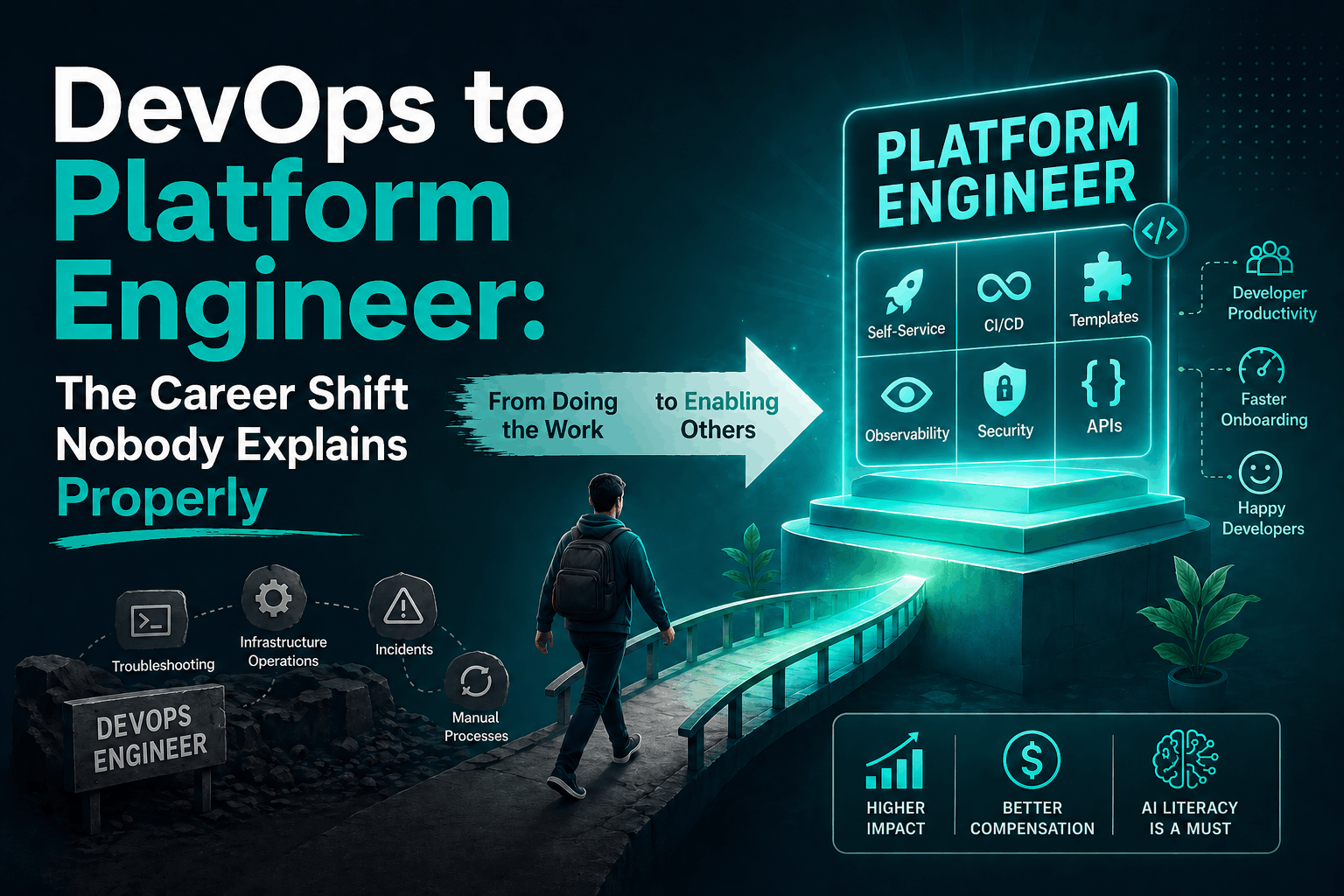
If you've been in DevOps long enough, you've probably seen the job postings by now. "Platform Engineer." "Internal Developer Platform." "Platform-as-a-Product." The titles are everywhere. Gartner says 80% of large engineering organizations will have dedicated platform teams by 2026. That's up from 45% in 2022.
But nobody really explains what changes. Not the buzzwords. The actual day job. The skills. The salary. The headaches.
I work as a DevOps Engineer at a company that builds Kubernetes application platform. So I'm living in the middle of this transition every single day. Let me break down what's actually happening, what it means for your career, and whether you should care.
What's Actually Happening
Here's the short version: DevOps broke at scale. Not the philosophy. The practice.
When you have 5 teams and 20 services, DevOps works beautifully. Everyone knows everyone. You can walk over to someone's desk (or Slack them) and figure out why the pipeline broke. The "culture of collaboration" actually functions.
But at 50 teams? 500 services? Multiple clouds? That informal shared context collapses. Onboarding takes weeks instead of days. Every team builds slightly different CI/CD pipelines. Security reviews become bottlenecks. And you end up with 3 senior engineers who "know how things really work," and they're drowning.
Platform engineering is the response to that breakdown. Instead of relying on culture and tribal knowledge, you build a product, an Internal Developer Platform (IDP), that encodes best practices into self-service tooling.
The platform becomes the documentation. The guardrails become the governance. And the paved road becomes the easiest road.
DevOps vs Platform Engineering: The Real Differences
Let's skip the marketing fluff. Here's what actually changes:
| Aspect | DevOps | Platform Engineering |
|---|---|---|
| Who you build for | Infrastructure, pipelines | Developers (your users) |
| How work comes to you | Tickets, Slack pings, "can you help me" | Platform feature requests, adoption metrics |
| Governance | PR reviews, approval gates, manual checks | Embedded into templates and workflows |
| Success metric | "Did the deploy work?" | "Are developers choosing to use the platform?" |
| Scale model | Linear (more teams = more DevOps) | Leverage (platform scales once, serves all) |
| Your mindset | "Let me fix this for you" | "Let me build it so you never need to ask" |
That last row is the fundamental shift. DevOps is a service mindset. Platform engineering is a product mindset.
A Day in the Life
DevOps Engineer's typical day:
- Build and maintain CI/CD pipelines (30%)
- Write Terraform, manage infrastructure (25%)
- Set up monitoring and alerting (15%)
- Automate deployment processes (20%)
- Help developers with infrastructure issues (10%)
Platform Engineer's typical day:
- Build internal developer tools and abstractions (35%)
- Improve self-service capabilities (25%)
- Maintain the platform infrastructure itself (20%)
- Developer support, education, onboarding (10%)
- Platform documentation (10%)
Notice the shift: you're spending more time building things for developers to use independently and less time doing things for developers. It's the difference between being a chef and being someone who designs kitchen layouts.
The Salary Question (India-Focused)
Let's talk numbers. I cross-referenced data from AmbitionBox, Glassdoor, Levels.fyi, and real job postings across LinkedIn and Naukri. Here is the realistic range for India in 2026:
| Experience | DevOps | Platform Engineer |
|---|---|---|
| 3-5 years | ₹10-28 LPA | ₹20-40 LPA |
| 6-10 years | ₹20-45 LPA | ₹35-60 LPA |
| Lead/Principal | ₹35-65 LPA | ₹55-90 LPA |
Platform engineering commands a 30-60% premium over generalist DevOps, according to multiple 2026 India salary reports. The premium exists because the talent pool is much smaller, you need DevOps foundations plus product thinking plus software engineering depth.
Globally, platform engineers in North America average $160,000 USD, compared to DevOps roles that typically plateau around $140K. Not life-changing, but meaningful.
The Skills Gap: What You Need to Learn
If you're a DevOps engineer today, you already have most of the foundations. Here's what's missing:
1. Product Thinking
This is the biggest mindset shift. You're no longer building pipelines, you're building a product with users, feedback loops, and adoption metrics. That means:
- Understanding developer pain points (user research)
- Prioritizing features based on impact (product management)
- Measuring adoption, not just uptime (analytics)
- Iterating based on feedback (continuous improvement)
The #1 reason platform initiatives fail? Teams build technically excellent platforms that nobody uses. Voluntary adoption is the real metric.
2. API Design and Software Engineering
DevOps scripting (Bash, YAML, a bit of Python) doesn't cut it anymore. Platform engineers need:
- API design - Your platform is consumed through APIs
- Go or Rust - Most CNCF platform tooling is written in Go
- Multi-tenancy patterns - Your platform serves multiple teams with different needs
- Software engineering practices - Testing, versioning, deprecation strategies
# Example: A Golden Path template for a new microservice
# This is what platform engineers build - opinionated defaults
apiVersion: backstage.io/v1alpha1
kind: Template
metadata:
  name: microservice-template
  title: Standard Microservice
  description: Spin up a new Go microservice with CI/CD, monitoring, and security baked in
spec:
  parameters:
    - title: Service Details
      required:
        - name
        - team
      properties:
        name:
          title: Service Name
          type: string
        team:
          title: Owning Team
          type: string
          enum: [payments, auth, core, platform]
  steps:
    - id: scaffold
      name: Generate Service
      action: fetch:template
      input:
        url: ./templates/go-microservice
        values:
          name: $
          team: $
This is a simplified Backstage software template - one of the most common patterns in platform engineering. Developers fill in a few fields, and the platform generates a production-ready service with CI/CD, observability, and security pre-configured.
You can achieve the same with Devtron's Application Templates - capture CI/CD workflows, build configs, deployment templates, and environment overrides from an existing app, then reuse them to spin up new microservices in minutes instead of hours.
3. Developer Experience (DevEx)
You need to care about how developers feel using your platform. This includes:
- Time to first deploy (how fast can a new dev ship?)
- Self-service capabilities (can they do it without filing a ticket?)
- Documentation quality (can they figure it out without asking you?)
- Error messages (are they helpful or cryptic?)
The State of Platform Engineering Report recommends tracking DORA metrics (deployment frequency, lead time, change failure rate, MTTR) alongside SPACE metrics (developer productivity) and time-to-onboarding.
4. AI Literacy
This isn't optional anymore. 92% of CIOs plan AI integrations into their platforms. The recommendation is to reserve 20% of your time for AI skill development:
- Using AI tools for platform operations (K8sGPT, AI-assisted troubleshooting)
- Building AI-powered capabilities into your platform (intelligent autoscaling, anomaly detection)
- Understanding how AI-generated code flows through your CI/CD
By 2028, platforms without AI capabilities will be considered outdated.
How to Actually Make the Transition
Here's a practical roadmap, assuming you have 3+ years of DevOps experience:
Month 1-2: Build Product Thinking
- Read "Team Topologies" by Matthew Skelton and Manuel Pais
- Start treating your current internal tools as products - add documentation, gather feedback, track usage
- Learn about Backstage (CNCF project, 89% market share for IDPs)
- Explore Devtron - an AI-native Kubernetes management platform to see how real IDPs work in practice
Month 3-4: Level Up Software Engineering
- Pick up Go if you haven't already - most platform tooling is Go-based
- Build a small internal tool with proper API design, tests, and documentation
- Contribute to an open-source platform tool (Backstage, Crossplane, Port)
Month 5-6: Get Hands-On with IDPs
- Deploy Backstage locally or in a sandbox cluster
- Build a software template for your team's most common workflow
- Add golden paths for your existing infrastructure patterns
Ongoing: Develop AI Competency
- Experiment with K8sGPT for cluster troubleshooting
- Explore AI-assisted CI/CD (GitHub Copilot in Actions, AI-powered code review)
- Stay current with AI SRE tools (autonomous incident response is coming fast)
The Six Specialized Roles Within Platform Engineering
As the field matures, "platform engineer" is splitting into distinct specializations:
- Head of Platform Engineering (HOPE) - Strategic direction, cross-functional coordination
- Platform Product Manager (PPM) - Bridges technical teams and organizational needs
- Infrastructure Platform Engineer (IPE) - Underlying infra (servers, networks, databases)
- DevEx Platform Engineer (DPE) - Developer workflows, friction reduction, tool UX
- Security Platform Engineer (SPE) - Security embedded into pipelines, policy-as-code
- Reliability Platform Engineer (RPE) - Evolution of SRE, monitoring/observability plane
You don't need to pick one immediately. Most platform engineers touch multiple areas, especially in smaller teams. But knowing these exist helps you see where your career can go.
What I'm Seeing From the Inside
Working at Devtron, a company that literally builds a Kubernetes application platform, I get a front-row seat to this transition. Here's what I see daily:
Teams that adopted platform thinking are shipping faster with fewer incidents. They're not firefighting as much because the platform catches common mistakes before they reach production.
Teams that didn't are drowning in tickets. Every new microservice means another pipeline to build, another set of alerts to configure, another on-call rotation to manage. It doesn't scale.
The companies that get this right treat their platform as a product with a dedicated team, clear ownership, and actual user research. The ones that get it wrong rebrand their DevOps team as "Platform Engineering" and change nothing about how they work.
Don't be the second one.
The Honest Take
Platform engineering isn't replacing DevOps. It's DevOps growing up. The philosophy of collaboration, automation, and shared responsibility stays. What changes is the mechanism, from culture-dependent to platform-dependent.
Should you make the shift? If you enjoy building tools more than operating infrastructure, if you care about developer experience, and if you want to work on leverage (building something once that serves hundreds of developers) - yes.
The timing is right. Mid-level engineers with 3-5 years of experience are entering platform roles in growing numbers. You don't need to be a senior architect anymore. The field is democratizing, the salaries are competitive, and the demand is only going up.
Start by building one thing that removes friction for your team. Treat it like a product. See what happens.
Further Reading:
- Team Topologies - the org design book behind platform thinking
- Backstage.io - CNCF project for building developer portals
- Devtron - AI-Native Kubernetes Management Platform
- Platform Engineering community - reports, articles, and the annual State of Platform Engineering survey
- DORA metrics - the standard for measuring software delivery performance
Enjoyed this post?
Get AI + DevOps insights delivered to your inbox. No spam, unsubscribe anytime.